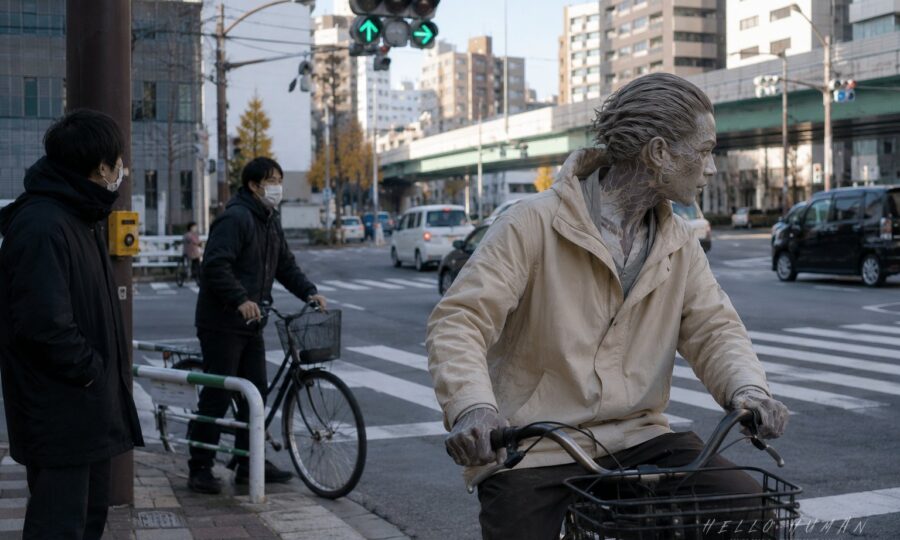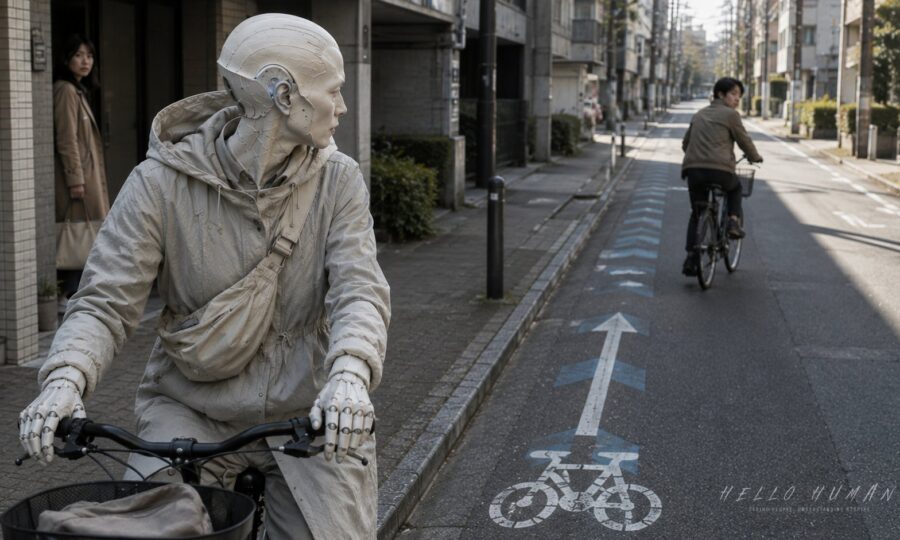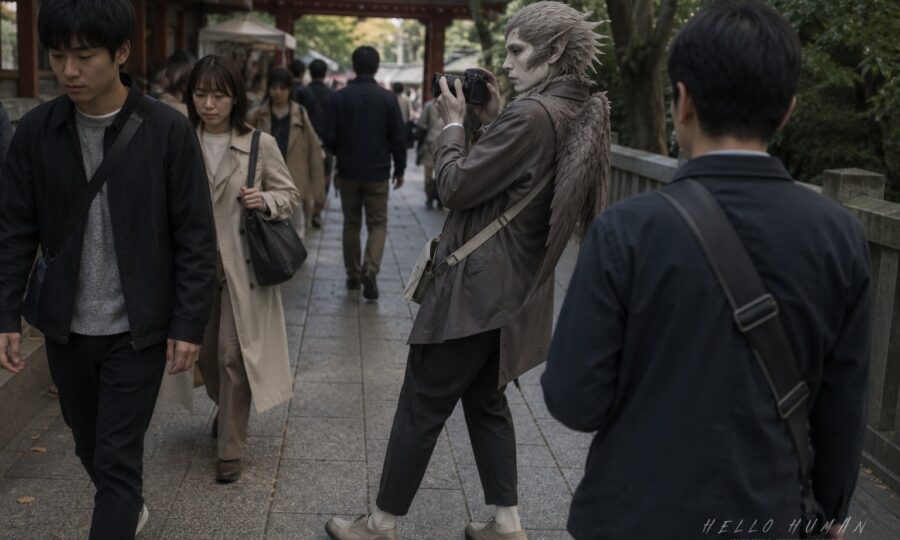
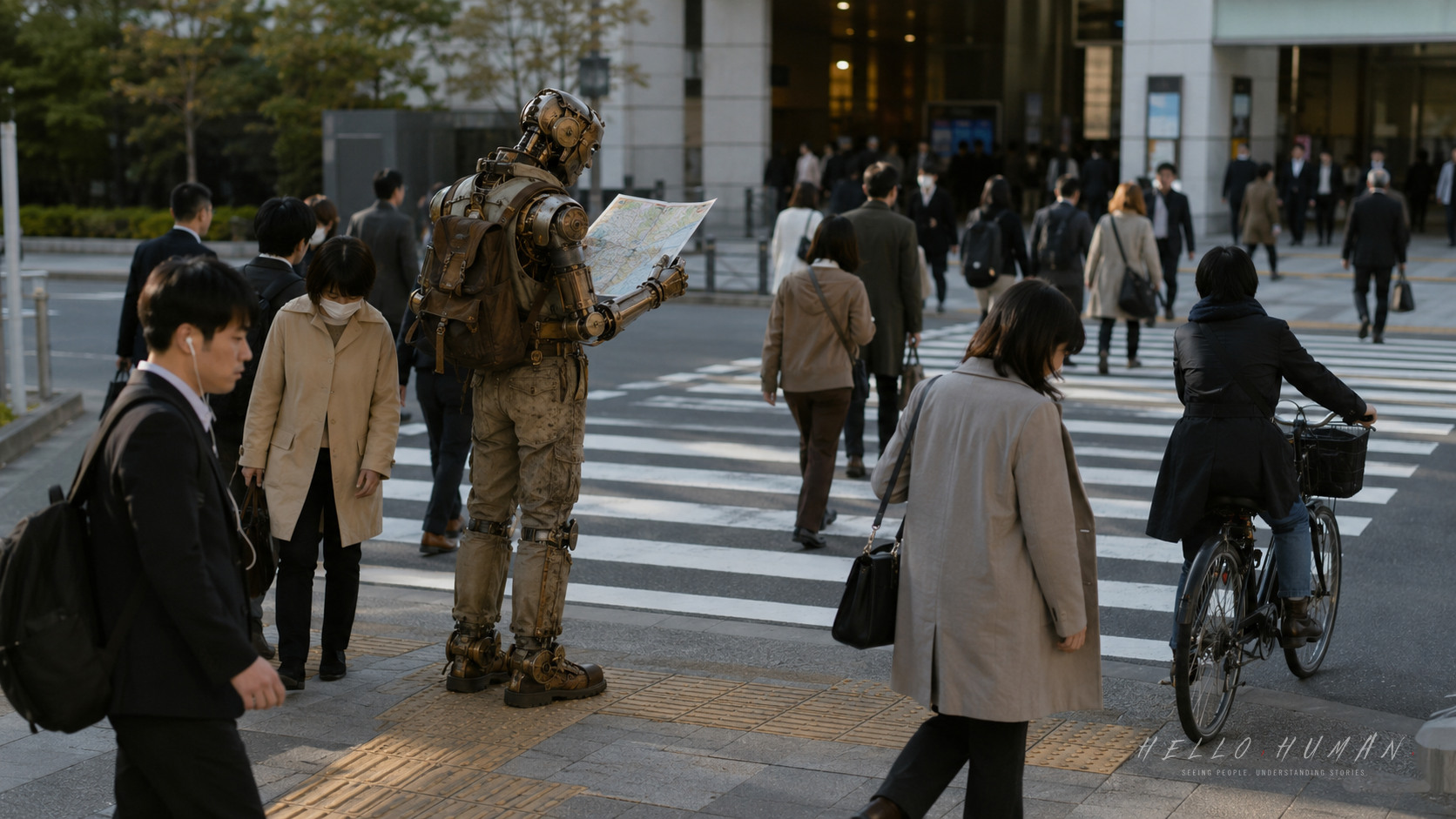
The crosswalk signal outside the Yokohama station exit was still red, and the white stripes ahead of it were empty in the afternoon light.
Karo stopped at the very edge of the curb, unfolded a paper map with brass-jointed fingers, and turned their broad elbows into the path of everyone waiting behind them.
Observation 01The Moment Something Changed

Karo had come out of the station with the others, carried forward by the slow pressure of commuters, shoppers, students, and umbrellas tucked under arms. Their elbows were matte and worn like old handrails. Their wrists turned with a quiet gear-like motion when they opened the map.
At first, the stop seemed normal. Everyone was waiting for the light. The mistake was where Karo chose to wait: not a step behind, not to the side, but exactly where the first row would begin moving when the signal changed.
A woman in a beige coat arrived behind them and slowed too soon. She did not sigh. She adjusted the strap of her bag and shifted half a step to the left.
A man with a bicycle held the brake gently and angled the front wheel away from Karo’s brass elbow. The wheel did not touch anyone. It simply made a new line where the old one had been blocked.
Karo studied the map, trying to match station exits to street names. Their brass knuckles clicked once. The sound was small, but it landed in the sudden quiet around their shoulders.
No one told Karo to move. People began correcting the flow with their feet.
The first signals were sideways shifts, angled wheels, and a little extra distance.
The crosswalk edge was treated as a moving point, even while the signal was red.
Observation 02The Reactions No One Explained
The red signal held. More people reached the corner and found Karo at the front, still reading. They did not gather tightly behind them. The waiting shape widened, thin at the center and fuller at the sides.
A high school student looked up from his phone, saw the blocked edge, and placed one foot on the curb seam to Karo’s right. His friend followed, then pretended to check the traffic instead of the map.
An older man stepped behind the utility pole and waited there, even though it gave him a worse view of the signal. He folded his newspaper once, then held it against his chest.
A woman holding a child’s hand bent slightly and murmured something. The child tried to stand at the front. The woman drew the child back with two fingers around the sleeve, leaving a clear strip of pavement before the crosswalk.
The signal for cars changed to yellow. The crowd’s posture altered before the walking light did. Bags lifted. Heels turned forward. The air gathered itself into motion, but Karo’s map still occupied the edge.
People avoided direct confrontation by widening the waiting group instead of asking Karo to move.
Parents, cyclists, and commuters quietly adjusted their positions to preserve the future walking path.
The strongest hint came just before the signal changed, when everyone’s posture prepared to move except Karo’s.
Observation 03What the Traveler Finally Understood
The walking signal turned green. The melody began. For one brief second, nobody moved straight ahead.
Instead, the first row flowed around Karo’s left and right shoulders. The man with the bicycle walked in a careful curve. The woman with the child passed behind Karo, keeping the child close to her side.
Karo felt the rhythm break around them. Their brass joints gave a dry click at both wrists. The map lowered.
They stepped back from the curb, then farther aside, beside a closed storefront shutter where no one needed to launch into the crossing. The crowd immediately filled the space they had left, not with anger, but with relief so ordinary it almost disappeared.
Karo folded the map into a smaller square. This time, before looking down, they checked where feet were aiming. The next red light gathered a new group at the corner, and Karo stood behind the side line, still and clear of the first step.
Karo understood that a crosswalk edge is part of the street’s movement, not just an empty waiting place.
The correction came through flow: people curved, paused, widened, and filled the space once it opened.
In Japan, especially near station exits, stopping suddenly can disturb movement even when no one says anything.
Practical Takeaway
When you need to check a map, phone, bag, or message near a crosswalk, station exit, sidewalk, or shopping arcade in Japan, step fully to the side before stopping. Avoid standing at the curb edge, doorway, escalator landing, ticket gate exit, or the center of a pedestrian stream.
This matters because people often move through public space by reading rhythm and spacing rather than asking others to move. Leaving the first step open helps the whole group start smoothly when the light changes.
Pay attention when people curve around you, widen their spacing, stop earlier than expected, glance down at your feet, or become unusually quiet behind you. Those small reactions may mean you are standing where the flow is about to begin.