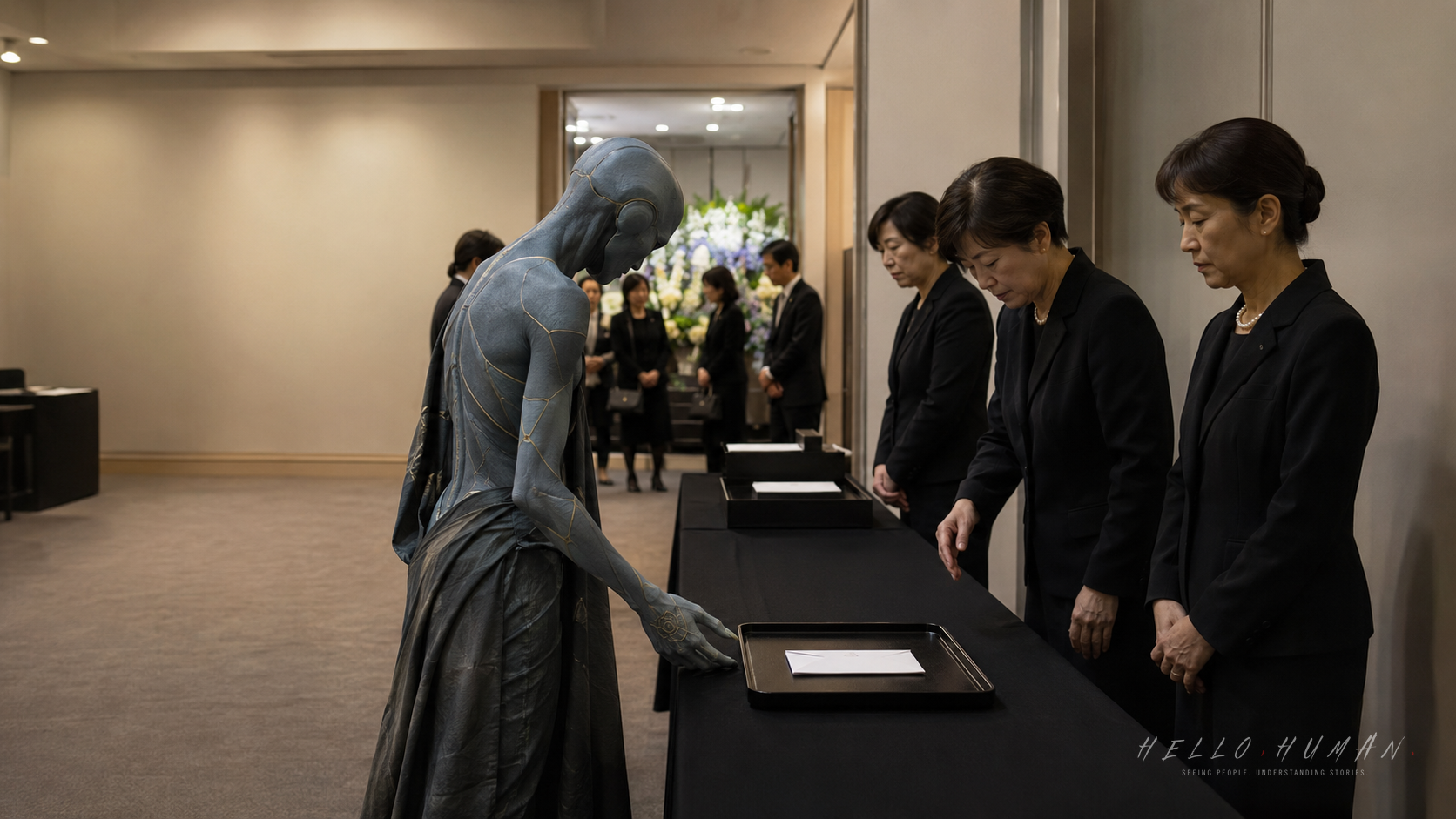
The black reception table stood just inside the funeral hall in Nara, its cloth pulled flat, its ink brush pens aligned beside a guest register.
Senu stopped at the edge of the room, and the thin boundary lines embedded in their ash-gray skin tightened around both palms.
Observation 01The Moment Something Changed

Senu had waited in the short line with the careful stillness of someone measuring every breath. Their body was not quite built for indoor thresholds. Each time the line advanced, their shoulders moved first, then their torso followed a half-second later, as if an invisible border had to release them.
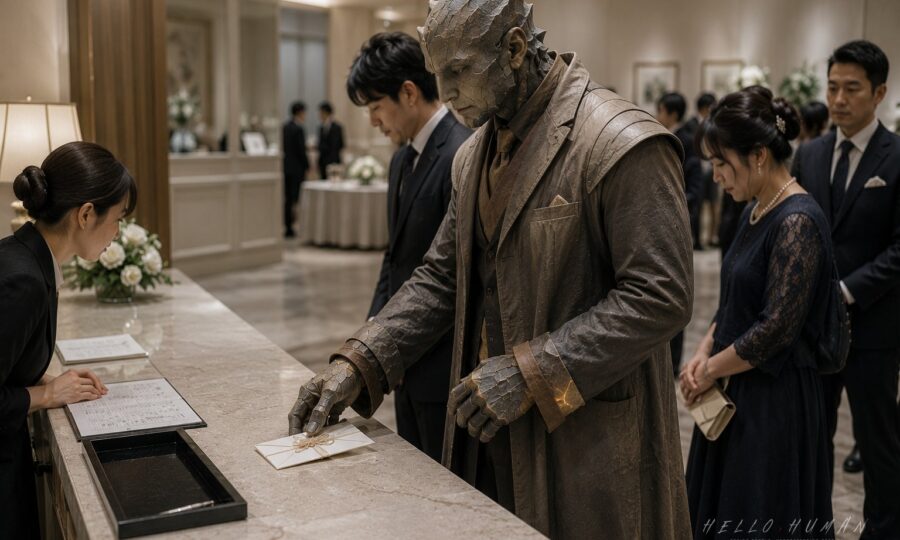
When their turn came, they bowed. The envelope rested between their long, jointed fingers, wrapped in a plain dark fukusa cloth they had been given outside. They unfolded it slowly, revealing the condolence envelope.
The envelope was placed on the tray with the front facing Senu, not the receptionist. Its top edge pointed toward Senu’s chest. The black-and-white cord lay slightly diagonal, and the written name faced the wrong direction for receiving.
The woman behind the table did not say, “That is wrong.” She lowered her gaze to the envelope, then to Senu’s marked palms. Her right hand moved forward, paused above the tray, and returned to the guest register.
Beside her, a man in a black suit shifted his feet by the width of one shoe. His voice dropped when he spoke to the next receptionist. The line behind Senu became quieter, not impatient, just thinner in sound.
No one corrected Senu directly. The first reaction was a pause.
The receptionist’s hand almost moved, then stopped, leaving space for Senu to notice.
The quiet around the table became the signal that the envelope had not entered the exchange smoothly.
Observation 02The Reactions No One Explained
The receptionist looked down again, not at Senu’s face, but at the envelope’s direction. Her expression stayed composed. Only the corners of her shoulders changed, drawing inward as if making herself smaller.
The man in the black suit reached for another tray, though the first tray was already there. He set it down beside the envelope, then angled it slightly toward Senu. The movement was small enough to look like tidying.
An older woman waiting behind Senu adjusted her own fukusa cloth. She turned her envelope once in her hands, front outward, name facing the table. She did not look at Senu while doing it.
A younger attendant stepped closer to the guest register and pointed with the brush pen toward the writing line. His finger did not touch the envelope. His voice was soft enough that the people behind could pretend not to hear.
Senu’s boundary marks tightened at the wrists. The lines usually reacted to doors, gates, and rivers, but here they responded to posture. A social edge had appeared where there was no wall.
The staff corrected the situation by arranging objects, not by naming the mistake.
Another guest demonstrated the expected direction without making Senu the center of attention.
Lowered voices kept the funeral reception calm and allowed the mistake to be repaired quietly.
Observation 03What the Traveler Finally Understood
Senu looked at the older woman’s hands. The guest bowed, held the envelope with both hands, and placed it so the receptionist could read it. The motion was not large. It was almost hidden inside the bow.
Senu lowered their head again. Their fingers touched the edge of their own envelope. For a moment, the embedded lines in their palms darkened, as if marking the border between holding and giving.
They rotated the envelope carefully. The name now faced the receptionist. The cord sat straight. Senu pushed the tray forward by only a few centimeters, then withdrew both hands at once.
The receptionist’s shoulders released. She bowed, accepted the envelope, and placed both hands around it. Her voice remained quiet, but the pause was gone.
Senu did not smile. Their face was built from matte plates of skin with no soft mouth, only a narrow breathing seam near the jaw. But the boundary lines around their wrists loosened, and their body crossed the next threshold without delay.
Senu learned that direction can carry respect in a formal Japanese setting.
The correction succeeded because the room offered examples before words.
At a funeral reception, smoothness matters because everyone is protecting the family’s grief.
Practical Takeaway
At a Japanese funeral reception, keep the condolence envelope wrapped until you reach the table, then present it with both hands so the front faces the receptionist. Move slowly, bow, and let the receiver read the name without needing to turn it around.
This matters because the envelope is not only money. It is a formal expression of sympathy, and the way it enters the exchange helps keep the reception calm, respectful, and easy for the staff and grieving family.
Pay attention when hands pause, voices lower, or someone quietly demonstrates a motion nearby. In Japan, especially in formal and ceremonial settings, the useful correction may arrive as spacing, posture, or the direction of an object.