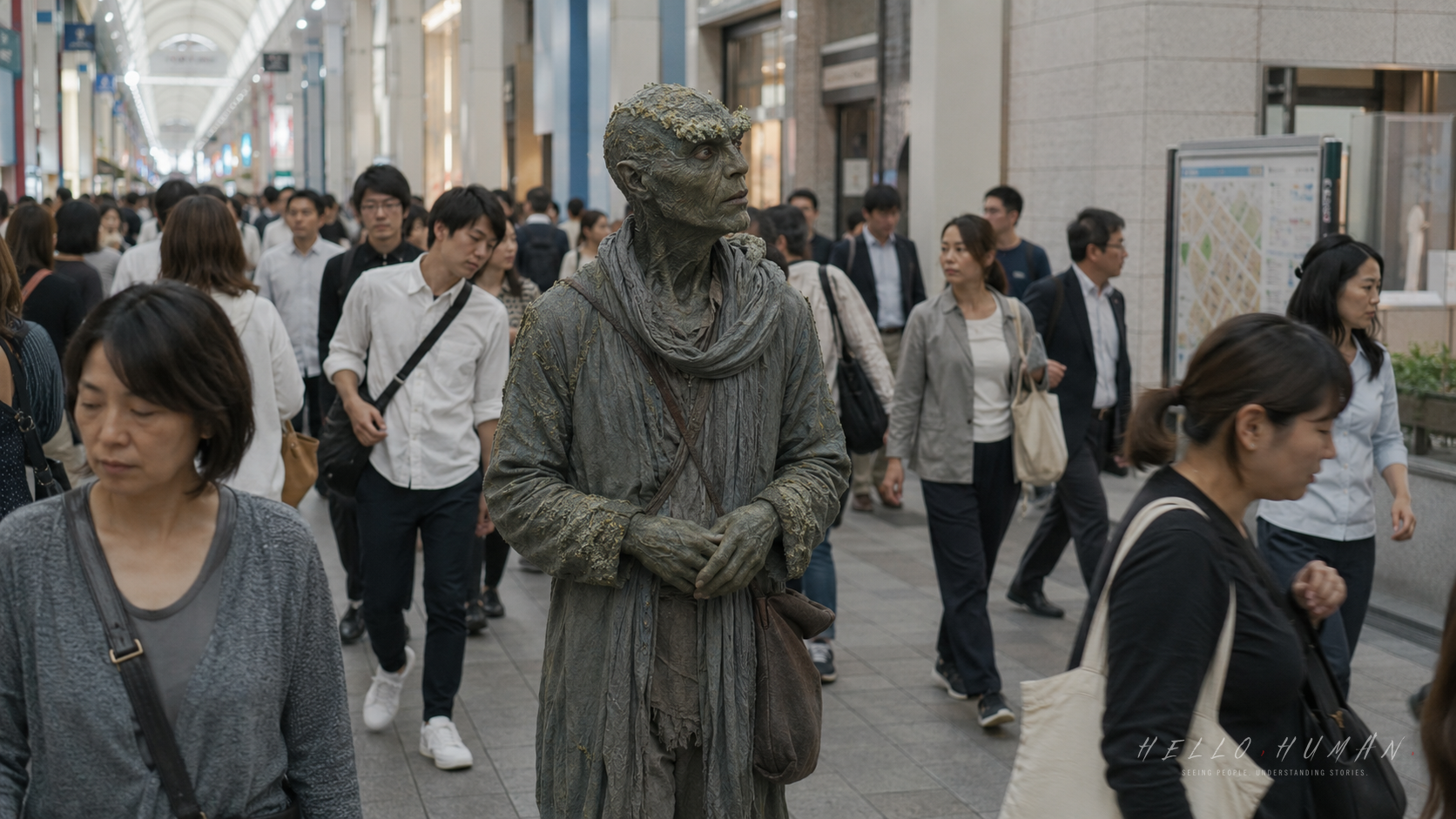
The shopping arcade in Hiroshima moved under a high roof of pale panels, its floor carrying the steady sound of shoes, umbrellas, and shopping bags.
Olan walked in the center of the flow, lichen grown into their brow bones dimming slightly as people began to curve around them.
Observation 01The Moment Something Changed

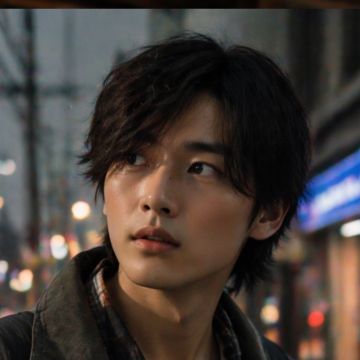
Olan had entered the arcade from a side street, drawn by the roof, the lamps, and the soft protection from the rain outside. Their dry green-gray skin held uneven organic ridges along the cheeks, and the lichen at their brow was not decoration. It grew directly into the bone line above their eyes.
They moved slowly because every storefront seemed to change the air. A bakery released warmth. A pharmacy door opened with a clean, sharp smell. A display of folded towels held their attention for three full steps.
Behind them, a woman carrying groceries shortened her stride. Her plastic bags stopped swinging and hung still against her knees.
A student with a backpack came up behind Olan, slowed, then moved right with a narrow turn of the shoulders. He did not look annoyed. He only passed with his body made thinner.
Olan paused near the center line of the arcade to examine a map board. The people behind them did not stop all at once, but the walking pattern loosened, then bent around their stillness.
No one told Olan to move faster. The first signal was the crowd changing shape.
People shortened their steps, narrowed their shoulders, and passed without direct eye contact.
The center of the arcade was being used as a walking lane, not a place to stop and study.
Observation 02The Reactions No One Explained
A man in a dark coat approached from the opposite direction and shifted closer to the shopfront before reaching Olan. His eyes stayed on the floor ahead, reading the path rather than the face.
Two friends walking side by side became single file for a moment. The one behind glanced toward a display window, pretending the narrowing had been their own choice.
A bicycle delivery worker pushing a bike through the arcade slowed behind Olan and let the front wheel drift slightly left. He did not ring the bell. He waited for an opening that would not startle anyone.
An elderly woman stepped out from a stationery shop, saw the uneven movement, and held back at the doorway. She looked at the passing feet first, then at the space near the wall where Olan was not standing.
Olan’s lichen dimmed a little more in the crowded indoor air. The change was small, a muted green-gray at the brow, but they felt it as pressure: not anger, not danger, only many bodies making quiet corrections around one slow point.
Pedestrians adjusted before speaking, using footwork and spacing to avoid confrontation.
Pairs became single file, cyclists waited, and people near doorways delayed entering the stream.
The repeated movement toward the edges showed where a slower walker could safely pause.
Observation 03What the Traveler Finally Understood
Olan looked down the arcade and finally saw the pattern. People were not rushing randomly. They were holding a shared pace, each person leaving just enough room for the next.
The map board stood near the center, but the open space beside a closed shutter was only two steps away. Olan moved there, slowly at first, then with a clearer angle that told others they were leaving the stream.
The crowd filled the space behind them almost immediately. The woman with groceries walked through without changing her face. The delivery worker passed with the bike straightened again.
Olan stood near the shutter and read the map from the side. Their shoulders relaxed. The lichen along their brow regained a faint dry color, no longer pressed by the passing air of people moving around them.
When they returned to the arcade flow, they waited for a small gap, then matched the pace for several steps before looking again. The storefronts remained interesting. They simply stopped asking the whole crowd to slow down with them.
Olan understood that walking pace is part of public cooperation in busy Japanese pedestrian spaces.
The correction came through curving paths, delayed steps, quiet passing, and people showing the usable edge.
Stopping or slowing is fine when done from the side, where the flow can continue without awkward pressure.
Practical Takeaway
In a Japanese shopping arcade, sidewalk, station exit, or crosswalk approach, try to match the pace of the people around you. If you need to check a map, look at a storefront, answer a message, or slow down, move fully to the side first.
This matters because crowd movement often depends on quiet prediction. When someone slows in the center, others may have to curve, shorten steps, or wait without wanting to say anything directly.
Pay attention when people pass closely around you, become single file, avoid eye contact, slow behind you, or angle toward the edges. Those small reactions may mean your pace is interrupting the shared flow.