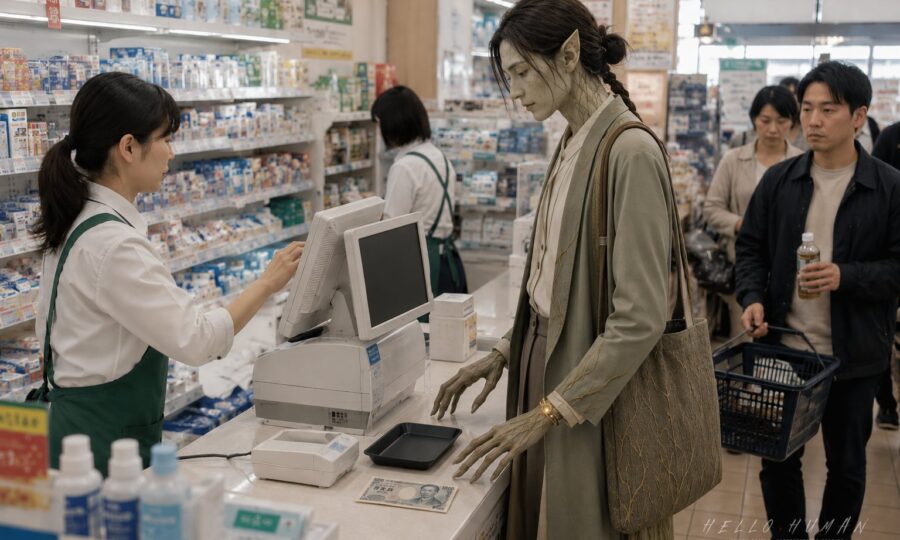
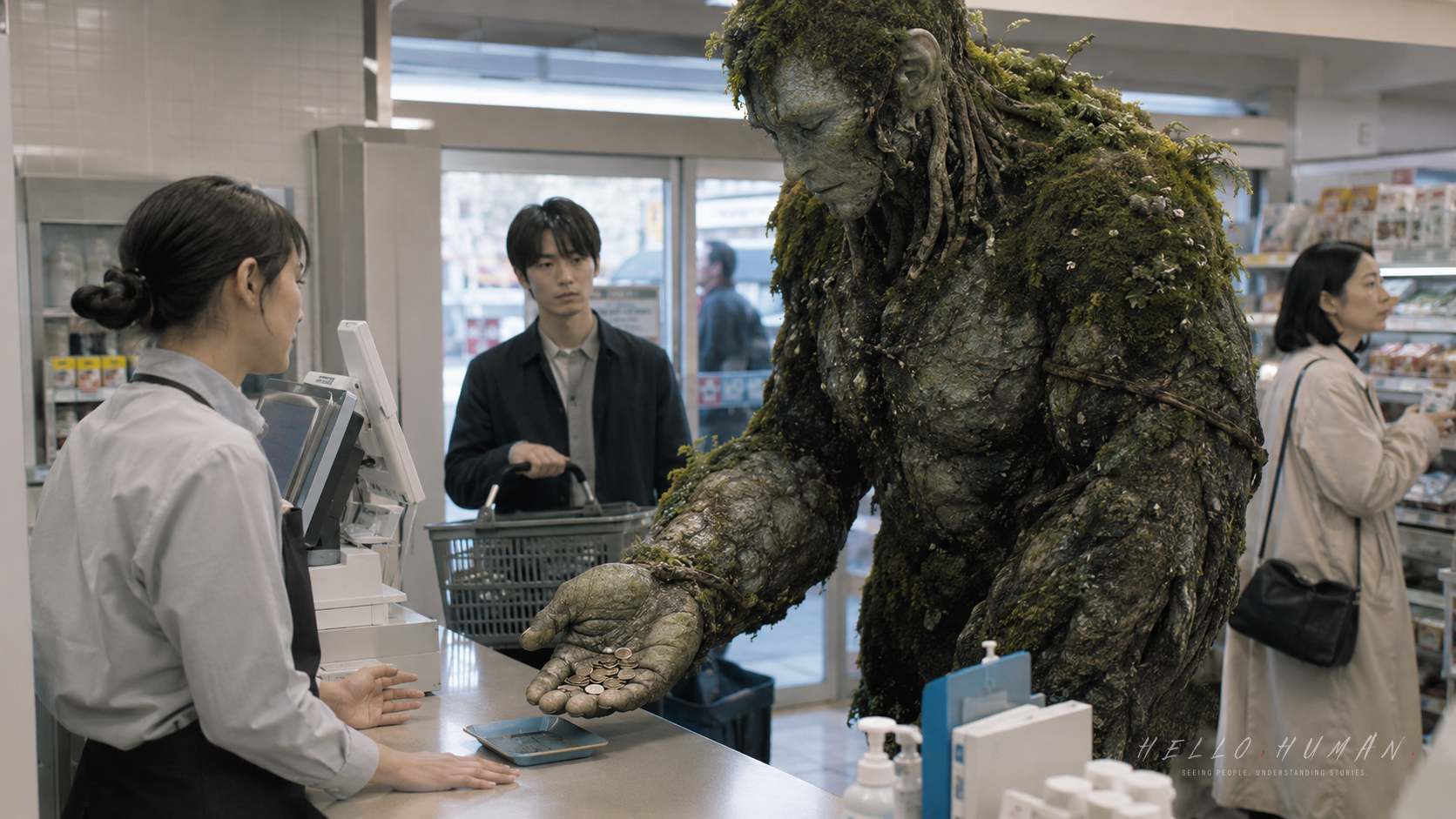
The cashier’s small plastic tray sat between the scanner and the register, clean and empty under the bright lights of an Osaka store.
Goro leaned forward with three coins balanced on his broad moss-dark palm, offering them directly across the counter.
Observation 01The Moment Something Changed


Goro was not trying to be forceful. His body simply made every small movement look large. Moss grew naturally along the ridges of his shoulders, and his bark-dense forearms rested with the slow weight of roots finding soil.
The cashier had already scanned the rice ball, bottled tea, and hand towel. She said the total softly and turned one hand toward the tray.
Goro missed the gesture. He had watched other customers pay quickly, but from his height he had seen only hands moving near the counter. He extended his own hand, palm up, the coins shining against dark bark skin.
The cashier’s fingers stopped halfway. Her smile stayed in place, but her hand did not take the coins. Behind Goro, the line became still for one quiet second.
His forearm had also covered part of the tray, hiding the little payment space from view. The object meant to organize the exchange had disappeared beneath him.
The first signal was a pause, not a correction.
The cashier’s hand turned toward the tray before it reached for the money.
The mistake was visual as much as social: Goro’s arm blocked the object everyone else expected to use.
Observation 02The Reactions No One Explained
The cashier lowered her gaze briefly to the covered tray, then back to the coins. She did not move away from him. She only held the moment open, as if the counter itself needed time to speak.
A woman behind Goro shifted her shopping basket from one hand to the other. The plastic handles clicked once. She looked at the tray, then looked down at the floor marker where the next customer was supposed to wait.
A student near the drink shelf slowed his steps and pretended to study the refrigerated cans. His eyes flicked toward the register, then away before Goro could meet them.
The cashier repeated the total in the same gentle tone. This time, her fingers touched the edge of the tray. It slid a few centimeters forward, making a small dry sound against the counter.
Goro heard the sound before he understood it. The moss along his shoulders compressed softly, as it did whenever a crowd narrowed around him. He pulled his elbow inward, but the coins remained on his palm.
The line did not complain. No one stepped around him. The pressure stayed in small movements: a basket held closer, a voice lowered, a glance returning again and again to the empty tray.
The customers did not react to Goro as a problem. They reacted to the stalled exchange.
The cashier avoided taking the coins directly, but she also avoided making him feel openly corrected.
The tray became the center of the conversation, even though no one named it.
Observation 03What the Traveler Finally Understood
Goro looked down at the counter again. This time he saw the tray clearly: not decoration, not a spare dish, but the place where the payment was supposed to land.
He moved first, before saying anything. His elbow folded back, his heavy forearm lifted away from the tray, and his large fingers lowered the coins into it one by one.
The cashier’s shoulders softened almost invisibly. She took the tray closer, counted the coins, and placed the receipt and change back into the same space.
Goro did not reach for her hand again. He waited for the tray to return. When it did, he picked up the change with two careful fingers, as if the small plastic dish had become part of the language of the store.
The woman behind him moved her basket forward. The student by the drinks resumed walking. The register’s rhythm returned, not because anyone had explained the rule, but because the shape of the exchange had become readable again.
Goro gave a small nod. Bits of moss on his shoulder rose back into place. He had learned that payment in Japan can be polite not only through words, but through distance, surface, and the shared use of a simple tray.
The correction came physically first: Goro uncovered the tray and placed the coins there.
The cashier’s relief appeared as smoother movement, not as praise.
The lesson was practical: at a register, the tray protects the rhythm and distance of the exchange.
Practical Takeaway
At cash registers in Japan, place cash, coins, or cards on the payment tray when one is provided. Keep your hand, bag, phone, or wallet from covering the tray so staff and the next customer can see the exchange clearly.
This matters because the tray creates a small neutral space between customer and staff. It helps avoid awkward hand-to-hand contact, makes counting easier, and keeps the register flow calm without anyone needing to explain it aloud.
Pay attention at convenience stores, bakeries, pharmacies, department store counters, and small service desks. If the cashier gestures down or slides a tray forward, use that surface first.