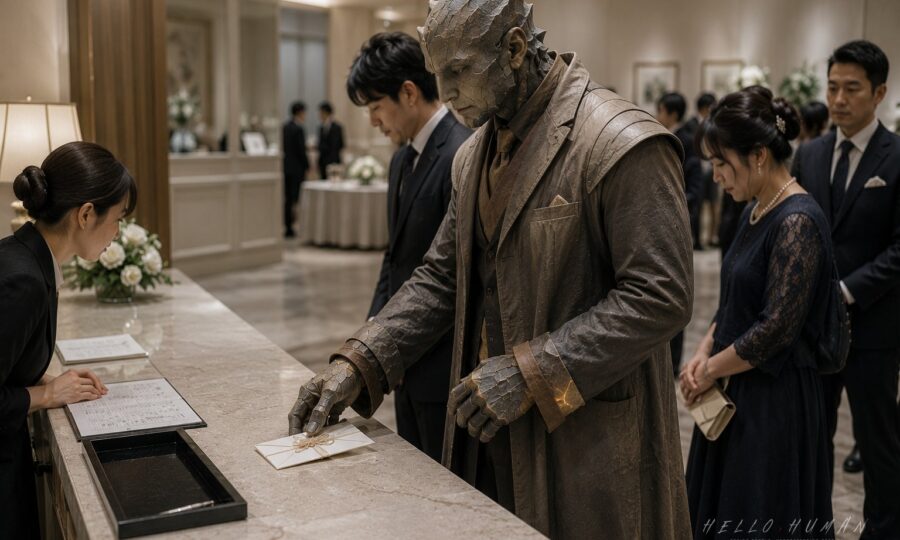
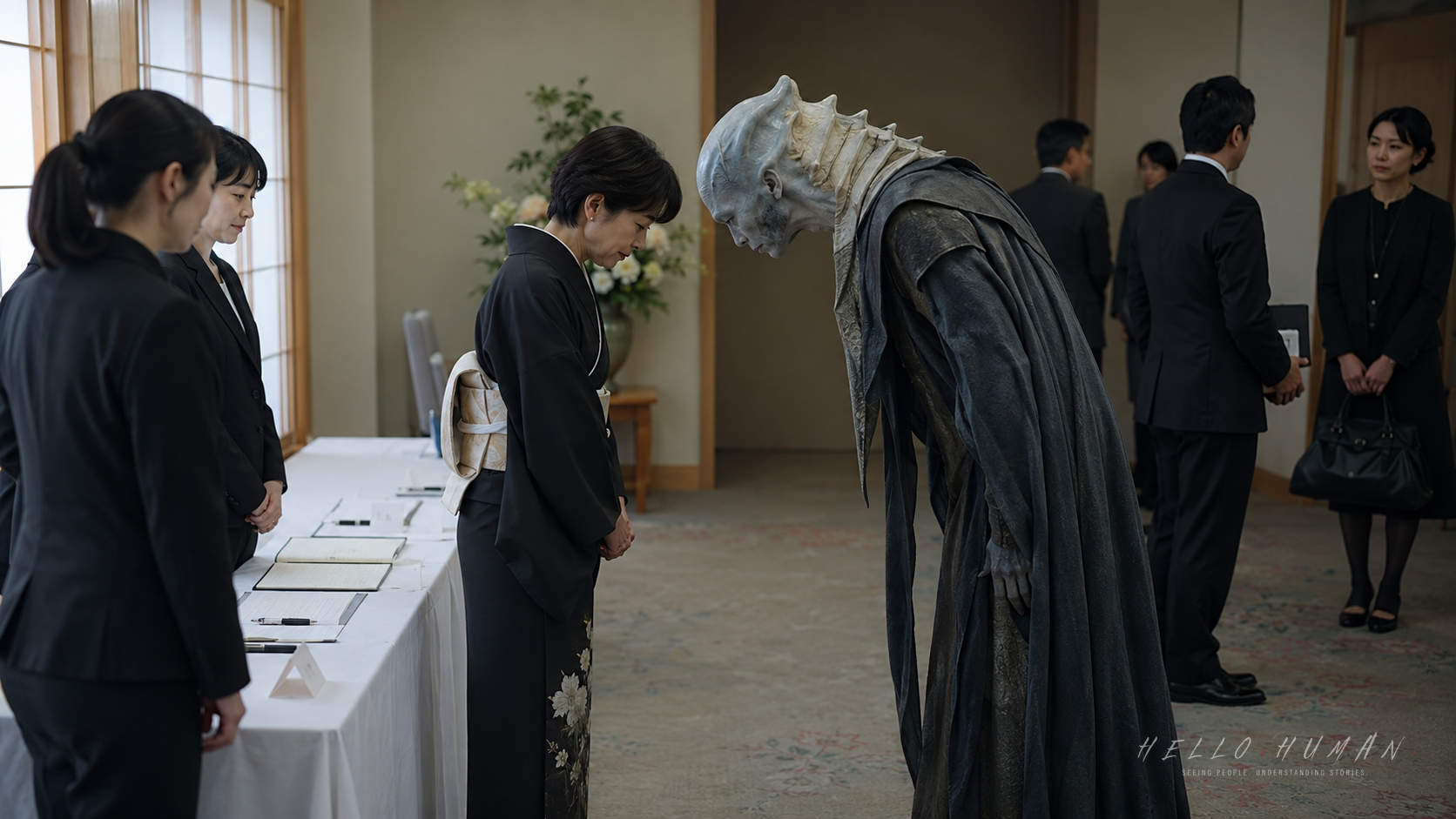
The reception table in the Kyoto community hall had white cloth, name cards, and a row of pens lined up beside a guest book.
Iru stepped close to the host, folded at the waist, and bowed so near that the salt-pale ridges of their forehead nearly entered the host’s personal space.
Observation 01The Moment Something Changed

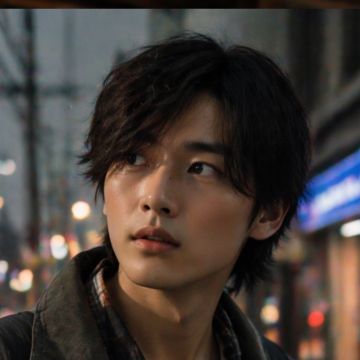
Iru had entered with quiet care, their tidal breathing rising and falling beneath a formal dark jacket. Salt-pale bone ridges shaped their collar and jaw, wave-smoothed and solid, not decoration but the frame of the body itself.
The host stood near the guest book, greeting visitors one by one. Each person stopped at a small distance, exchanged a short phrase, and bowed from where their feet already were.
Iru watched the bowing. They understood the bend, but not the space before it. When their turn came, they stepped forward until their toes nearly reached the table leg.
The host began to bow at the same time. Then he stopped halfway, his shoulders tightening under the black suit. His hands, already prepared to receive Iru’s name card, paused over the table.
A woman beside the guest book lowered her eyes to the floor between them. The space there had become too small to ignore, and too delicate to mention.
No one told Iru to step back. The first signal was the host’s interrupted bow.
Paused hands showed that the greeting could not continue smoothly at that distance.
The lowered gaze toward the floor made the missing space visible without saying it aloud.
Observation 02The Reactions No One Explained
The host took a small step back. It looked natural, almost like making room for another guest to pass behind him, but it opened a safer distance between their faces.
The woman at the table straightened one of the pens, then slid the guest book a little toward Iru. The movement invited Iru’s hands forward while keeping their body farther away.
A man waiting behind Iru stopped one floor tile earlier than the person before him had. He did not look at Iru. He simply demonstrated a wider pause for the next greeting.
Another guest near the wall bowed to someone she recognized, leaving a clear arm’s length of space before bending. Her bow was quiet, ordinary, and perfectly placed.
Iru’s collar ridges dampened faintly in the dry indoor air. Their tidal breath slowed. They had thought closeness made the greeting warmer. Around them, every body was showing that respect needed room to be received.
The host corrected the distance by stepping back rather than naming the mistake.
The guest book was moved forward so Iru could participate without crowding the host.
Other guests modeled the expected spacing through where they stopped before bowing.
Observation 03What the Traveler Finally Understood
Iru looked at the floor tiles, then at the host’s feet. The pattern was simple once seen: stop, leave space, speak briefly, bow. The distance was not coldness. It was the shape that allowed both people to move politely.
They placed their name card on the table and stepped back by one tile. Their wave-smoothed jaw lowered again, this time from a distance that did not force anyone else to retreat.
The host bowed fully. His hands resumed their motion, taking the card and guiding Iru toward the guest book with a small open palm.
The woman beside the table smiled with less tension. The man behind Iru stayed where he was, leaving the same space. The reception line regained its quiet rhythm.
Iru signed the guest book slowly. Before moving on, they gave one more small bow from the correct distance. Their collar ridges dried, their breathing steadied, and the room no longer bent away from them.
Iru understood that formal greetings in Japan often depend on distance before gesture.
The correction came through feet, hands, furniture, and examples rather than direct instruction.
A bow feels smoother when both people have enough space to complete it without backing away.
Practical Takeaway
At a formal reception, ceremony, shrine-related event, temple visit, or community greeting in Japan, stop with enough space before bowing. Avoid stepping very close first, especially near reception tables, guest books, hosts, elders, or people in formal clothing.
This matters because a bow is a shared movement. Leaving space lets the other person bow back, receive your greeting, and keep the exchange calm without needing to step away from you.
Pay attention when someone pauses mid-bow, takes a small step back, lowers their eyes to the floor between you, moves an object forward, or tightens their smile. Those subtle reactions may mean the greeting distance is too close.