The covered arcade in Hiroshima moved like one long breath, umbrellas closed, lunch bags swinging, shoes tapping under the roof.
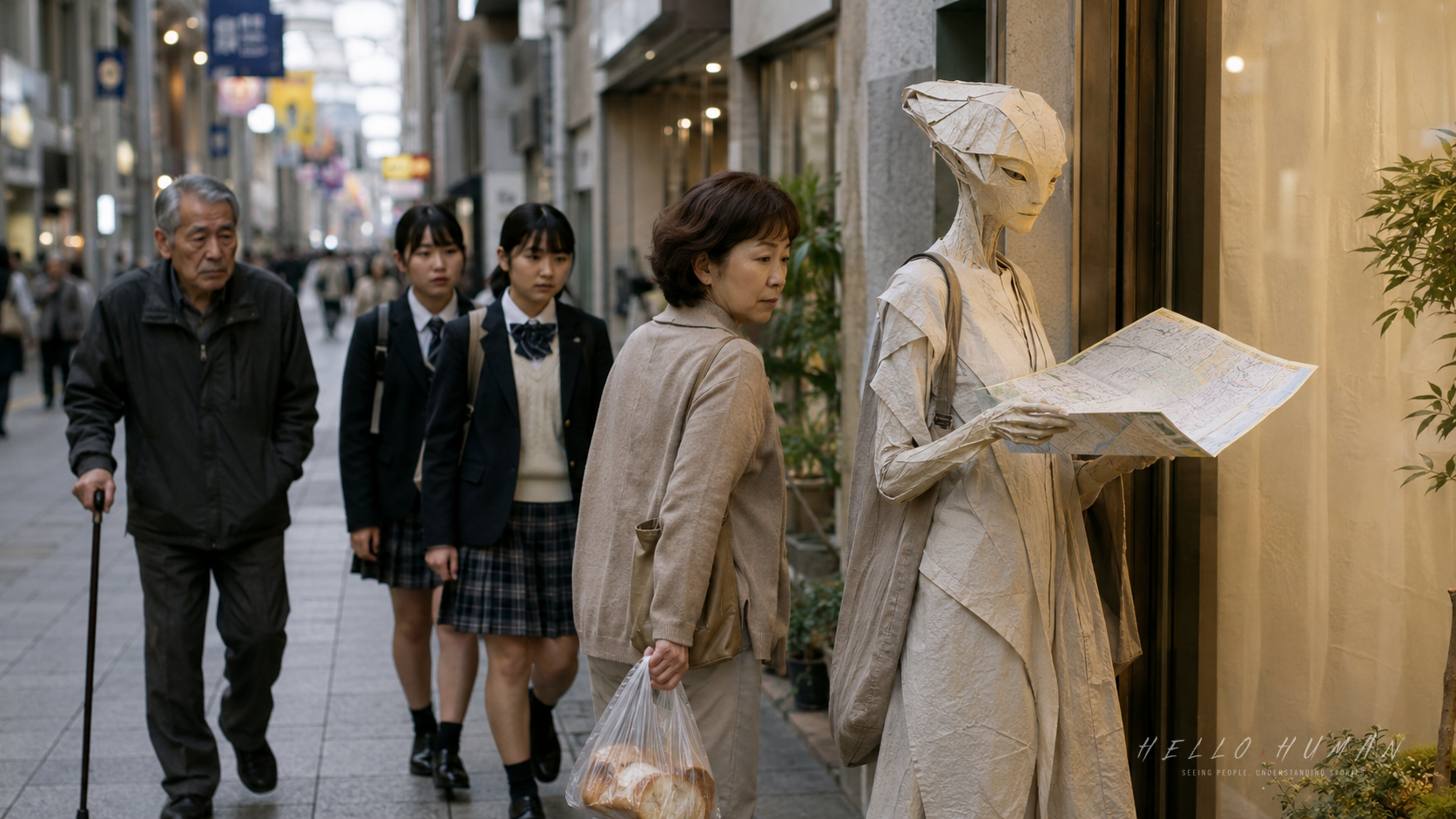
Sefu stopped beside a storefront display, unfolded his map with both paper-thin hands, and turned his whole body toward the people walking straight toward him.
Observation 01The Moment Something Changed

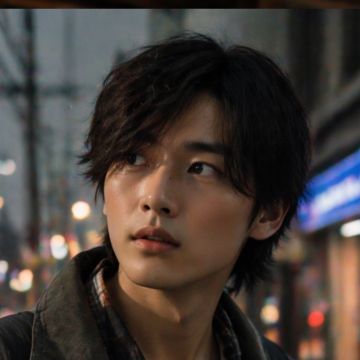
Sefu was not large. His body looked made from many layers of washi, pale at the edges and fibrous where his wrists folded. His eyelids bent softly instead of blinking, and each breath lifted the paper around his collar in tiny uneven ripples.
He had noticed the middle of the arcade was busy. That part he understood. So he stepped near the storefront, pleased with himself, and opened a paper map almost the same color as his hands.
The mistake came in the turn. Instead of standing parallel to the walking stream, Sefu faced back into it. His folded shoulders pointed outward. The map spread from his chest like a small screen. One corner crossed the narrow lane where people were already trying to pass the shop entrance.
A woman carrying a bakery bag slowed first. Her eyes did not stay on Sefu’s face. They moved to the map edge, then to the gap between his shoulder and the next person’s umbrella. She folded her elbow closer to her body and slipped by sideways.
Behind her, a man in a gray suit shortened his stride. His foot landed early, then early again. The smooth pace of the arcade broke into two small hesitations before the stream joined itself around Sefu.
The first sign was a change in walking rhythm.
Sefu had moved off the center, but his body still faced into the moving lane.
In a narrow pedestrian flow, direction can block as much as position.
Observation 02The Reactions No One Explained
The arcade did not stop. It thinned around him. Two high school students walking side by side became single file before they reached the storefront, then spread out again after passing.
A mother with a small child shifted the child to her inside hand. She gave Sefu’s map one quick glance, then looked down at the floor as if choosing a safer line through the crowd. The child’s shoulder brushed the mother’s coat instead of the paper edge.
An older man with a cane paused near a vending machine alcove. He did not sigh or stare. He simply waited for three people to pass Sefu, then took the wider curve, placing the cane carefully outside the uneven stream.
A shop clerk came to the entrance with a tray of small wrapped items. She slowed when she saw Sefu facing the flow. Her hands stayed level. She waited for a narrow opening, stepped around his map, and returned to the display without asking him to move.
The Japanese reactions were almost too polite for Sefu to notice. No one raised a voice. No one pointed at the floor. The message appeared in tightened shoulders, shortened steps, and bodies turning thinner than they needed to be.
Only when a draft from the automatic door behind him touched his neck did his paper fibers tighten. The plies along his jaw pulled flat. He looked up from the map and saw that everyone near him had become narrow.
No one treated Sefu as a problem aloud.
The crowd corrected itself by curving, compressing, and slowing.
Repeated sideways movement can mean your stopping place is still taking space.
Observation 03What the Traveler Finally Understood
Sefu lowered the map a little. The next pair of pedestrians approached, already preparing to bend around him. Their eyes moved not to the storefront, but to the angle of his body.
That was the part he had missed. He had found the edge, but he had not joined its shape. He was standing like a question placed across the answer everyone else was already walking.
He folded the map once, then again, making it smaller before he moved. His paper fingers creased the corner too sharply, and a faint dry sound came from his knuckles. Then he stepped closer to the storefront until his shoulder no longer reached the passing lane.
After that, he turned. Not toward the crowd. Not fully toward the glass. He stood parallel to the stream, his body long and flat beside the shopfront, with the map held close to his chest.
The next people did not have to become narrow. A woman with a tote bag passed without changing her stride. The older man with the cane returned from the far side of the arcade and walked through the lane Sefu had cleared.
Sefu watched the difference. It was not dramatic. That made it clearer. The arcade’s breath became even again, and his own paper collar loosened by a few fibers.
The correction was physical before it was verbal.
Sefu cleared the lane by shrinking the map, stepping in, and turning with the flow.
In Japan’s busy pedestrian spaces, people often read your awareness through small adjustments like angle, distance, and timing.
Practical Takeaway
When you need to check a map, look at a storefront, or decide where to go in a Japanese shopping arcade, step fully to the side first. Keep bags, umbrellas, and papers close to your body, and turn parallel to the pedestrian flow rather than facing into it.
This matters because people may avoid asking you to move directly. Instead, they will often adjust around you, compress their shoulders, slow their steps, or take a wider path, which quietly spreads the delay through the walkway.
Pay attention when people keep curving around you, passing sideways, or shortening their stride near your position. Those small changes may mean you are not blocking the center, but you are still interrupting the flow.