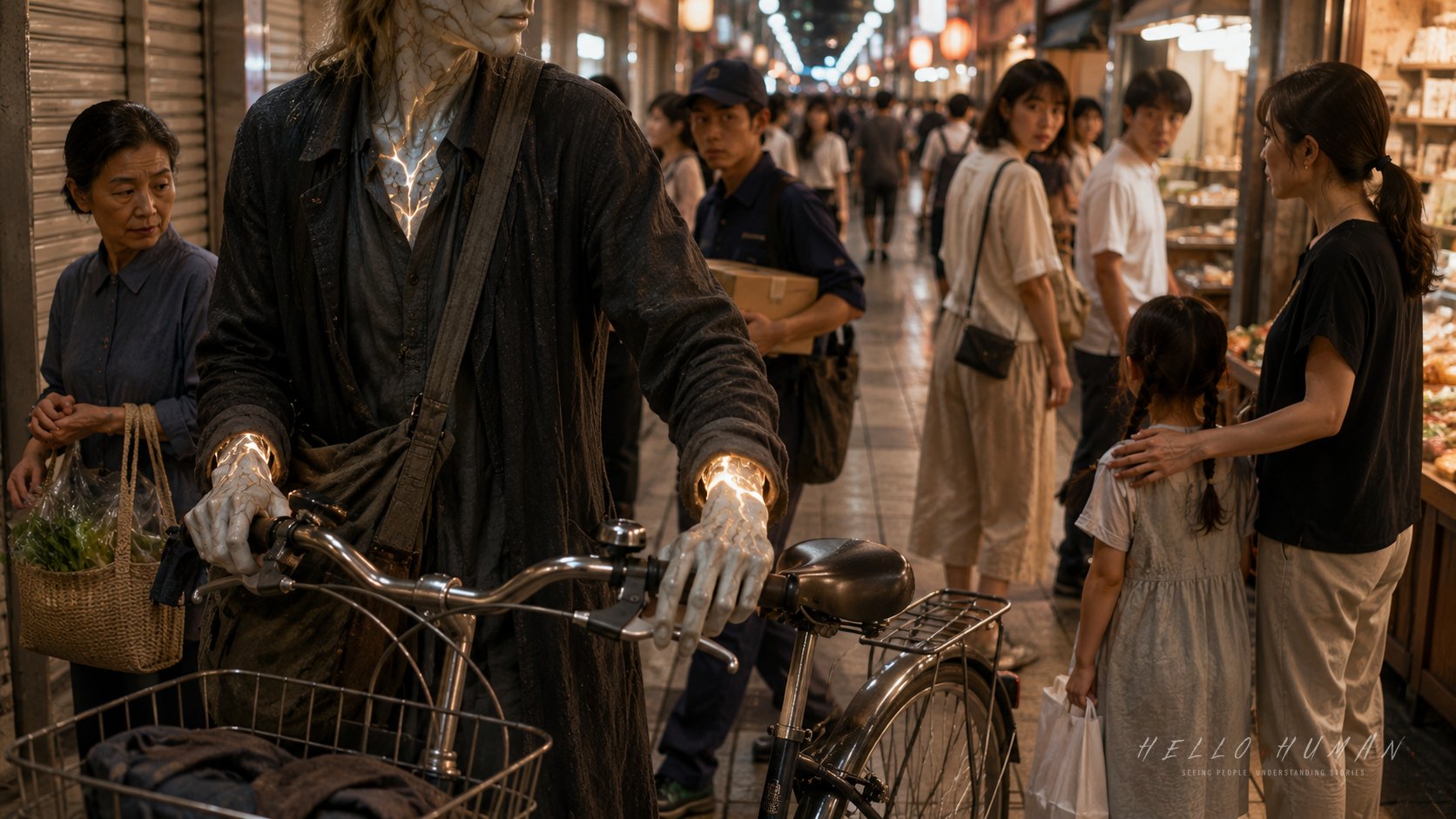
The covered shopping arcade in Osaka held the late-summer night inside a long strip of warm light, with shop shutters half-down and office workers still moving toward home.
Vey guided a bicycle by the handlebars through the mixed crowd, one smooth marble-veined hand on the grip and the other resting near the brake.
Observation 01The Moment Something Changed

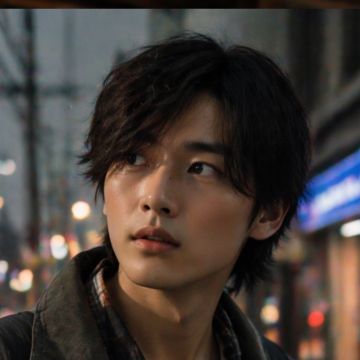
Vey was not riding fast. He was barely rolling at all, one foot touching down every few steps, the front wheel turning carefully between handbags, shopping bags, and pairs of polished shoes.
His body carried a calm heaviness, not clumsy, but grounded. Subtle warm marble veins crossed his neck and hands, and his wrists had a smooth geometry that made the bicycle grips look slightly too ordinary beneath his fingers.
At first, the arcade seemed to make room. A young man with a convenience-store bag shifted left. A woman with a folded parasol moved closer to the shutter of a pharmacy. Two students stopped talking for half a second as the bicycle wheel passed between them.
Vey read the silence as permission.
Then the flow tightened. The bicycle’s handlebar did not strike anyone, but it asked every passing body to calculate around it. Its front basket edged into the path before Vey did. Its back wheel delayed the space after he had already passed.
The visible cue was a bicycle rolling through a pedestrian arcade, slow enough to seem careful but wide enough to make everyone else adjust.
The Japanese reaction began as quiet parting: shoulders narrowing, bags pulled inward, and steps bent around the wheel without complaint.
Vey first understood only that people were making way, not yet that their silence was carrying the inconvenience for him.
Observation 02The Reactions No One Explained
An older woman carrying groceries stopped beside a closed storefront and let Vey pass before stepping back into the middle. Her face did not accuse him. Her body simply waited out the bicycle.
A delivery worker walking the other direction shifted his parcel against his chest and turned his shoulders sideways. The motion was efficient, practiced, and almost invisible, but it made his own path smaller so the bicycle could remain large.
A couple near a takoyaki shop paused at the edge of the lighted counter. One of them glanced down at the front wheel, then lifted his eyes away before meeting Vey’s face.
A boy holding his mother’s hand stepped behind her leg when the handlebar came near. The mother lowered her hand slightly, guiding him inward without saying anything to Vey.
Vey noticed the separate reactions one by one. A pause here, a sidestep there, a gaze dropping toward the tire and then disappearing. Still, no one said the bicycle should not be there, and no sign in front of him made the matter simple.
The faint glow near his collarbone began to show through the open neck of his dark linen jacket. It was not bright, only a warm thread inside the marble veins, appearing under pressure as he realized the arcade was not accepting the bicycle. It was absorbing it.
The visible cue became the crowd’s shape around the object: people were not walking with Vey, they were parting around the bicycle.
The Japanese pedestrians kept the correction indirect, using spacing, pauses, and angled shoulders instead of turning the arcade into a confrontation.
Vey began to understand that moving slowly did not remove the burden if the object still forced others to solve its path.
Observation 03What the Traveler Finally Understood
Vey stopped beside the edge of a closed shop, pulling the bicycle fully out of the center stream. He turned the front wheel inward, parallel to the shutter, so the handlebar no longer reached into the passing line.
His hand stayed on the brake. Then he stepped to the outside of the bicycle, placing his own body between the object and the pedestrians, making the machine smaller by taking responsibility for its shape.
A narrow space opened in the arcade. The older woman with groceries moved through without waiting. The delivery worker straightened his shoulders. The mother and child passed without the child hiding behind her leg.
Vey did not announce that he had learned. He gave a small bow toward the flow, almost more to the corridor than to any one person, and waited until a wider break appeared before moving again.
Only then did the practical meaning settle. In a shopping arcade in Japan, the issue was not whether the bicycle was dangerous in a dramatic way. It was that the bicycle changed a pedestrian place into a place where pedestrians had to negotiate with an object that did not belong in the center of their rhythm.
Slow movement had felt careful to Vey. But to the people around him, the care had arrived on their side of the equation. They were the ones narrowing, pausing, stepping back, and making room.
The correction was physical first: Vey stopped, turned the front wheel inward, and moved the bicycle out of the walking stream.
The Japanese reactions eased when the arcade’s flow no longer had to fold itself around the handlebar, basket, and rear wheel.
Vey understood that shared pedestrian space is not only about avoiding contact, but about not making others manage your object for you.
Practical Takeaway
In a covered shopping arcade or busy pedestrian passage in Japan, do not treat a slowly rolling bicycle as automatically acceptable. Dismount fully, keep the bicycle close to the side, walk only when there is enough space, or choose a street route where the bicycle does not make pedestrians part around it.
This matters socially because the bicycle’s size continues beyond your own body. Even at low speed, the handlebar, basket, pedals, and rear wheel can make strangers adjust their steps, bags, children, and shoulders without saying anything.
Pay attention when people step to storefront edges, angle their bodies, glance down at your wheel, pause with bags pulled inward, or let a narrow lane form around you. Those quiet changes mean the object has become the center of the flow.