The sauce bottle stood beside the chopsticks and napkins at the food court counter, its cap polished by many quick hands.
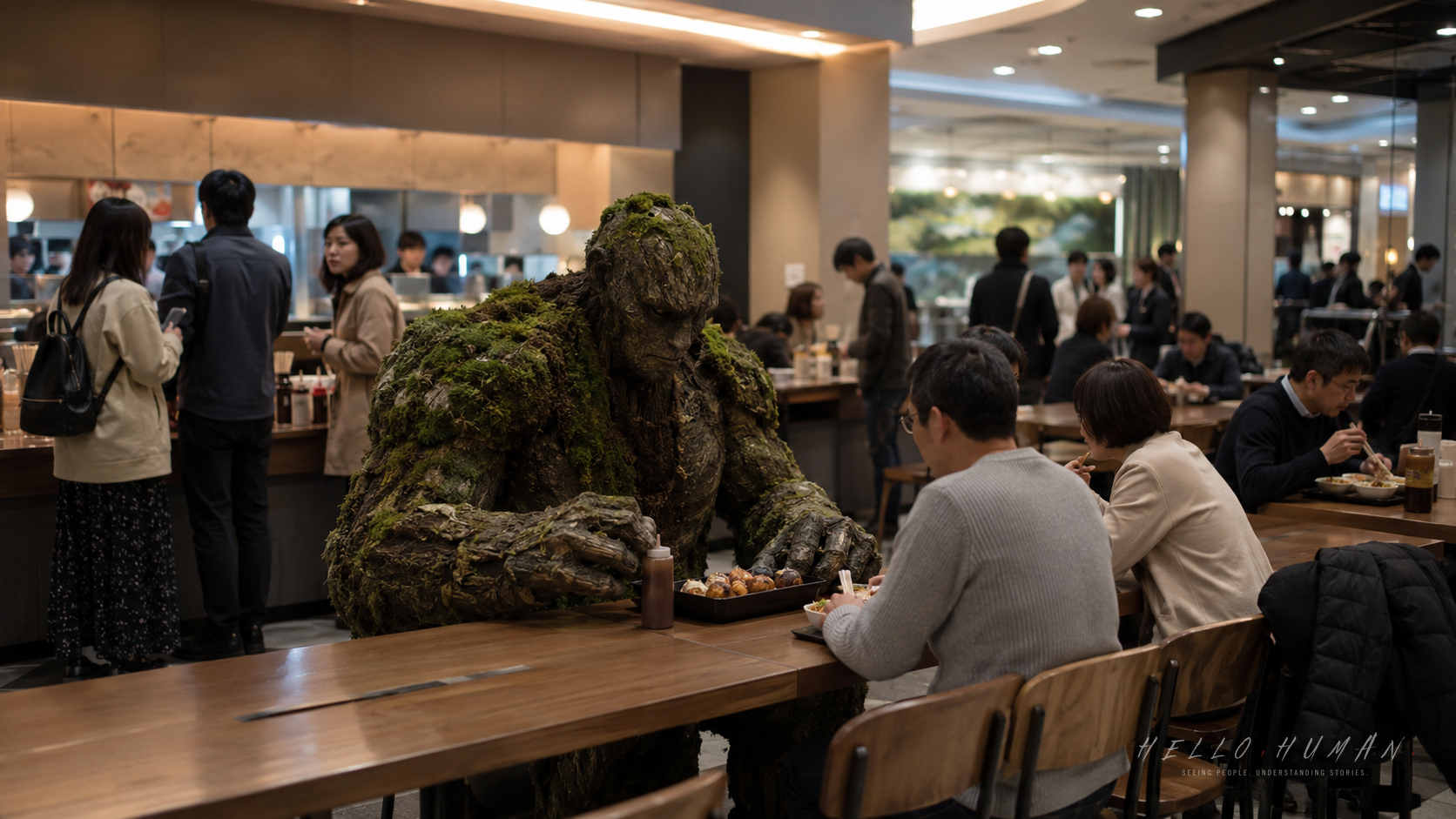
Brum picked it up after collecting a tray of takoyaki, then carried it back to the shared table as if it belonged with the meal.
Observation 01The Moment Something Changed


The lunch crowd in Osaka moved around Brum in narrow lanes. Trays passed from counter to table. Chairs scraped once, then settled. People carried their food with both hands and watched the open seats without staring.
Brum moved more slowly than the others. Moss grew naturally along their shoulder ridges, deep green where it met the neck and darker where it pressed against their bark-dense forearms. Their stance had the patience of something rooted in weather.
At the condiment counter, a man ahead of them squeezed sauce over his fried noodles, wiped the bottle’s rim with a paper napkin, and set it back exactly where it had been. Brum noticed the sauce. They did not notice the return.
They carried the bottle to the long shared table and placed it beside their tray. Then they adjusted the takoyaki one by one, adding sauce slowly, watching it gather in shining lines.
A woman two seats away reached toward the empty space at the condiment counter, then stopped. Her hand hovered above the chopsticks. She looked across the room, saw the bottle beside Brum’s tray, and looked down again.
No one told Brum to return the bottle. The first signal was a stopped hand.
The woman noticed the missing condiment, then avoided making Brum the focus.
The bottle had shifted from shared space into private space, and the room quietly registered the change.
Observation 02The Reactions No One Explained
A student carrying karaage stepped to the condiment counter and scanned the surface. His tray tilted slightly while he searched. He found mayonnaise, toothpicks, chili powder, and napkins, but not the sauce bottle.
He turned his head only halfway toward Brum’s table. His eyes touched the bottle, then moved away quickly. Instead of speaking, he picked up the chili powder, shook a little onto his plate, and returned it with more care than necessary.
At the shared table, an older man folded his paper napkin into a narrow rectangle and placed it between his tray and Brum’s bottle. It made a small border, polite and temporary.
A staff member passed behind the table with an empty tray. She slowed when she saw the bottle, then glanced toward the condiment counter. Her hand rose as if to clear dishes, but she continued walking.
The moss along Brum’s shoulders compressed softly. The crowd had narrowed around them without touching them. The missing bottle had become a little obstruction, not in the aisle, but in everyone’s timing.
Other customers searched first, then chose not to confront Brum directly.
People used glances, careful object placement, and unnecessary tidying to show that something was out of place.
The staff member noticed the problem but avoided interrupting the meal unless it became unavoidable.
Observation 03What the Traveler Finally Understood
Brum looked at the napkin border, then at the condiment counter. Another customer arrived there, paused, checked the bottles, and left without sauce.
For the first time, Brum saw the counter as a place of return, not a place of taking. The bottle was not part of their tray. It was a small tool passing through many meals.
They lifted it carefully between two broad fingers. A few crumbs of dried moss loosened from their wrist and caught on their sleeve. Brum brushed them away before standing, as if even that small shedding should not be left for others.
At the counter, they wiped the bottle’s side with a napkin and set it back beside the chopsticks. The label faced forward, close to the place where the man before them had left it.
The student with karaage noticed from the corner of his eye. He waited a breath, then stepped forward and used the sauce without looking toward Brum. The food court resumed its ordinary rhythm, tray by tray.
Brum understood that shared condiments should remain available to everyone, not stay at one table.
The correction came through waiting patterns and searching movements rather than direct complaint.
In Japanese shared dining spaces, returning small common items helps preserve the flow for people you may never speak to.
Practical Takeaway
At a food court, restaurant counter, or shared dining area in Japan, use shared condiments where they are placed, or bring them back immediately after a brief use. Do not keep a common sauce bottle, seasoning container, napkin stack, or utensil holder at your seat unless it is clearly meant for that table.
This matters because shared items support the whole dining flow. When one person keeps them, others may have to wait, search, or change their meal quietly instead of asking directly.
Pay attention when people glance at your table, pause near the condiment area, tidy surrounding objects, or choose another seasoning without speaking. Those small reactions may mean a shared item has accidentally become private.