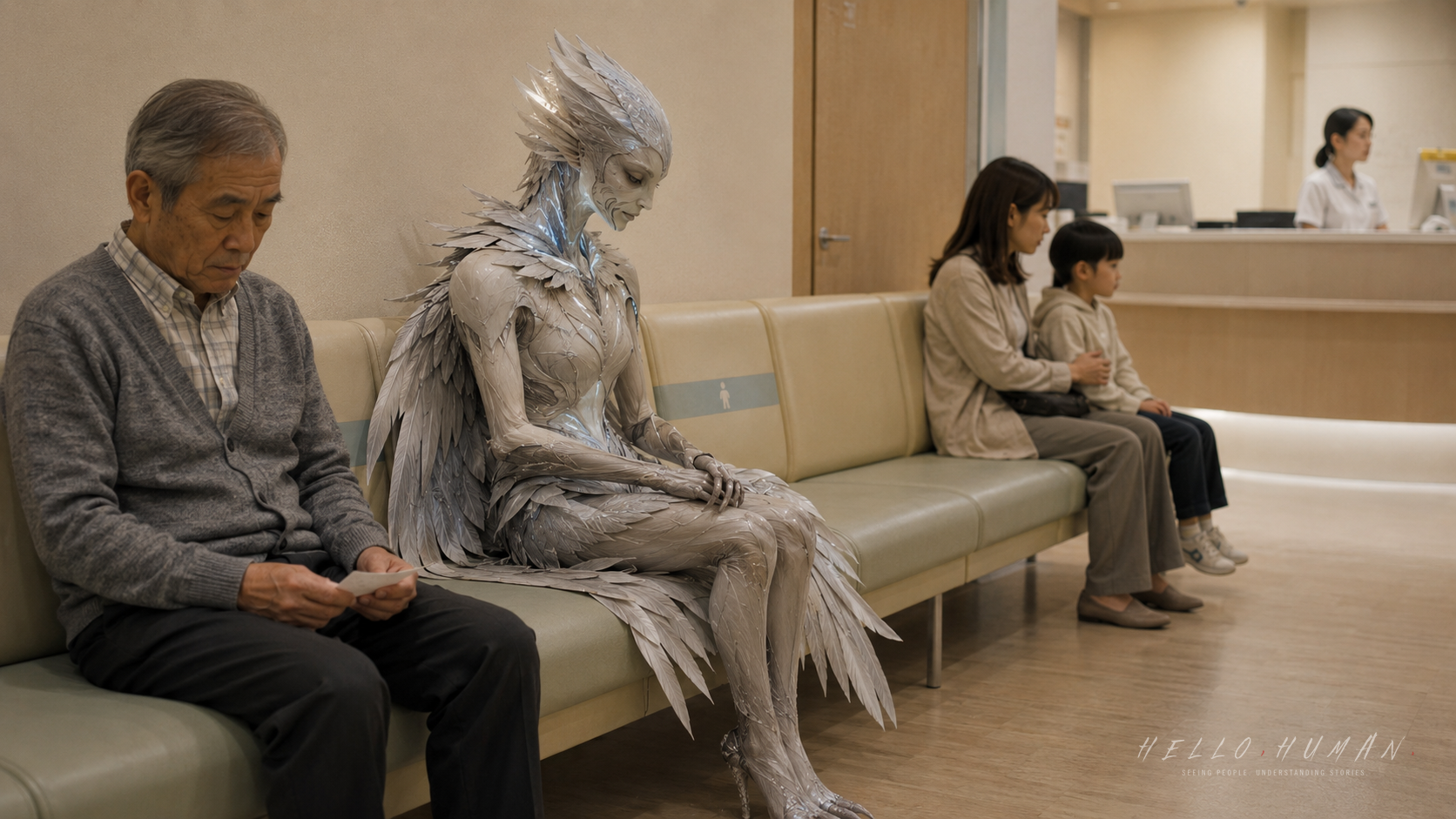
The clinic waiting room in Kobe had a row of pale chairs along the wall, with three empty seats between the reception desk and an elderly man reading a folded appointment slip.
Veyra chose the chair directly beside him.
Observation 01The Moment Something Changed

Veyra had entered carefully, holding her number card with both hollow-boned wrists. Her ash-gray feathers lay flat along her spine, not like costume wings, but like a second breathing surface that shifted when the room became too quiet.
The reception clerk had pointed toward the seating area. Veyra understood the gesture as simple permission: sit there. She did not understand that the open chairs were part of the message.
Her knees bent with a birdlike balance, and she lowered herself into the chair beside the elderly man. The row gave a small plastic sound under her weight. Her folded spine feathers spread slightly and covered part of a small seat-use marker on the chair to her other side.
The elderly man did not move at first. His appointment slip lowered by two centimeters. His eyes stayed on the paper, but his shoulders became narrower, drawn in toward the center of his coat.
A woman across the room paused before sitting. She looked at the open stretch of chairs, then at the tight space beside the elderly man, then chose a seat farther from both of them.
The mistake was visible before anyone reacted: Veyra sat close when distance was available.
The first response was a change in posture, not a complaint.
The covered seat marker made the seating pattern harder for her to read.
Observation 02The Reactions No One Explained
The elderly man folded his appointment slip once, then unfolded it again. He did not look at Veyra. His shoes shifted inward until both toes pointed toward the reception desk.
A mother with a child entered and slowed near the row. There were still empty chairs, but the shape of the room had changed. The open seats no longer looked evenly available because Veyra’s body and feathers made the middle of the row feel occupied.
The mother touched the child’s sleeve. They crossed to the opposite wall and sat under the window instead. The child started to ask something, but the mother answered in a lowered voice before the question became clear.
At the reception desk, a nurse lifted her eyes from the computer. She looked once at the open chairs, then at Veyra’s feathers covering the small marker, then back to the elderly man. Her hand hovered near the bell, but she did not call out.
Another patient came from the examination hallway and chose to stand near the magazine rack, even though a seat was open two chairs away from Veyra. He opened a magazine without turning a page.
Veyra felt the room grow wider around her and tighter at the same time. Her spine feathers flattened against the chair back. The ash tips trembled once, as if the air itself had become a quiet warning.
People avoided correcting Veyra directly, but they stopped using the nearby seats normally.
The room’s discomfort appeared through detours, lowered voices, and unused space.
In a waiting room, open distance can be a form of consideration.
Observation 03What the Traveler Finally Understood
Veyra looked along the row again. Empty chair, empty chair, elderly man, Veyra, empty chair half-hidden by feathers. The pattern suddenly looked uneven, like a sentence with the wrong word pressed against another.
She turned her head toward the covered marker. Her feathers had spread over it without intention. She lifted them carefully, drawing each ash-gray layer close to her spine until the chair beside her became visible again.
Then she stood. The movement was quiet but unmistakable. Her knees straightened in two soft stages, and she stepped two seats away, leaving a clear chair between herself and the elderly man.
The elderly man did not thank her. He did not need to. His shoulders loosened, and the appointment slip returned to its ordinary height. Across the room, the mother stopped holding her child’s sleeve.
Veyra sat again with her wrists tucked close to her lap. This time her feathers stayed within the width of her own chair. She looked at the open spaces before she looked at the people.
When the nurse called a name, a patient stood, and the room rearranged itself smoothly. Someone took the newly opened seat, leaving one chair between strangers. Veyra watched that space remain empty, not wasted, but useful.
Veyra’s correction came first through movement: she uncovered the marker, stood, and left a seat of space.
No one had to explain the rule once the seating pattern became visible.
The quietest seat in the room was the one left open between strangers.
Practical Takeaway
In a Japanese waiting room, clinic lobby, public seating area, or quiet shared space, avoid sitting directly beside a stranger when other seats are open. Leave one seat between you and the next person when the layout allows it.
This distance helps people share a small room without making anyone feel watched, crowded, or forced into contact. It also keeps the seating pattern easy for the next person to understand.
Pay attention when people keep choosing farther seats, standing despite open chairs, lowering their voices, or glancing at the space beside you. The room may be showing you where the comfortable distance is.