The wind outside the Tokyo department store had turned the entrance mats restless. Every time the automatic doors opened, a thin draft slipped through the lunch crowd and moved the paper shopping bags against people’s knees.
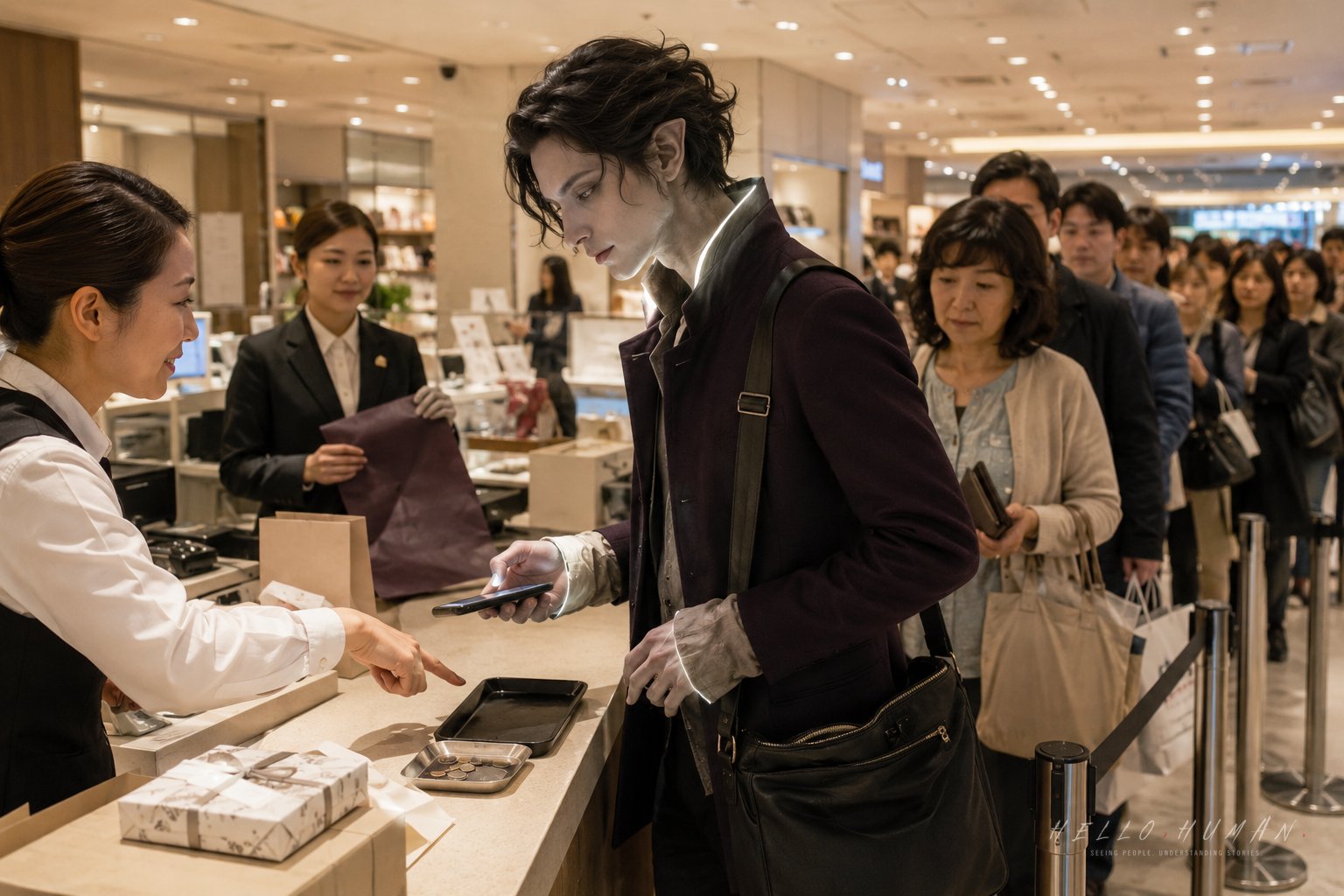
Selen stood at a counter near the gift floor, one wrapped box beside the register and a phone held ready above a small payment tray. The cashier looked at the phone, then at the shallow coin dish beside the register, and her hand stopped just before touching the keys.
Observation 01The Moment Something Changed


Selen had seen phones move quickly through other counters in Japan. A tap, a beep, a quiet bow, and the next person stepped forward. He wanted to be that smooth, especially with tourists gathering near the elevator and shoppers carrying boxed sweets through the aisle.
His body held stillness naturally. A high narrow collarbone line rose above his deep plum wool-blend jacket, softened by smoke-gray lining at the collar and cuffs. Cool temple shadows deepened under the fluorescent light, and his careful pale-knuckle hands kept the phone steady without waving it.
The counter, however, was arranged around cash. The tray was shallow and hard, placed directly in front of the cashier. Beside it sat a small coin dish with a few marks from years of use. There was no scanner visible where Selen expected one, only the register, the receipt printer, and the cashier’s waiting hand.
He offered the phone slightly lower, as if the angle might solve the silence. The cashier smiled with closed lips and inclined her head. Then she pointed, gently and without tapping, toward the coin dish.
Selen smiled back, thinking she was showing him where to place the phone. He moved it over the tray, screen facing upward, and waited for a sound that did not come.
The visible cue was a phone hovering above a counter arranged for cash: tray, coin dish, register, and no obvious place for a contactless tap.
The Japanese reaction began as a quiet gesture, not a refusal: the cashier paused, smiled, and pointed toward the coin dish.
Selen first understood the gesture as guidance for payment position, not as a signal that the payment method itself was wrong.
Observation 02The Reactions No One Explained
The woman behind Selen had already opened her wallet. When the phone stayed above the tray, she stopped separating bills and rested her thumb along the edge of the leather fold. Her eyes moved once to the coin dish, then down to the floor.
A man holding two boxed cakes shifted his paper bag from his right hand to his left. He did not step closer, though space had opened near the counter. His shoulders angled slightly away, making room for the cashier’s quiet correction to happen without an audience.
A store attendant at the side counter paused with a roll of wrapping paper in both hands. She looked toward the register, then lowered the paper to the counter more slowly than necessary. The movement made no sound, but it marked the delay.
The cashier tried again, still soft. She moved her fingertips toward the coin dish, then drew them back to her side so the gesture would not look like a command. “Cash,” she said in English, and nodded once toward the tray.
Selen’s phone remained in his hand for one more breath. The word was clear now, but the kindness around it made the moment feel strangely uncertain. No one had said no sharply. No one had told him he was holding up the line. The silence did that work instead.
A cool muted gleam touched the edge of his collar as he looked from the phone to the tray. He noticed the absence he had missed: no reader, no payment sticker he could understand, no cashier moving to accept the device. The counter had been explaining itself before anyone spoke.
The visible cue spread through the line: a wallet stopped half-open, a paper bag shifted hands, and wrapping paper paused at the side counter.
The Japanese reactions protected Selen from public correction while still showing that the register rhythm had become stuck around his phone.
Selen began to understand that polite patience did not mean the payment method was acceptable; it meant people were leaving him space to notice.
Observation 03What the Traveler Finally Understood
Selen brought the phone back against his palm and turned the screen inward. The gesture changed the counter immediately. The cashier’s hand returned to the register, the woman behind him opened her wallet again, and the boxed cakes rustled softly in their paper bag.
He reached into the shaded interior pocket of his matte shoulder bag. The pocket had been designed to keep daily items cool against his body, and his fingers moved carefully through folded receipts, a train card, and a small envelope of cash he had forgotten to prepare.
He placed bills on the tray with both hands, then added coins to the dish instead of sliding them across the counter. His pale knuckles stayed close to the surface. The cashier counted without hurry, placed the change back in the tray, and bowed with the same calm smile she had used before.
Selen bowed too, smaller than he intended. He picked up the wrapped box and stepped aside before putting the phone away properly. Only after leaving the register space did he sort the receipt, the change, and the bag strap against his shoulder.
The lesson arrived after the repair, not before it. In that department store, the tray was not decoration. The coin dish was not an old habit beside a modern system. Together, they were a quiet payment language, and the cashier’s pointing finger had been the gentlest possible translation.
The physical correction was clear: the phone went down, the screen turned inward, and cash moved onto the tray and coin dish.
The Japanese response eased through resumed motion: the cashier counted, the next wallet opened, and the waiting line recovered its lunch-hour rhythm.
Selen finally understood that cash-only cues can be physical before they are verbal, especially at small or specialized counters inside larger stores.
Practical Takeaway
At a department store counter in Japan, look at the objects before assuming phone payment will work. If the cashier points toward a tray or coin dish, lower the phone first and prepare bills or coins instead of waiting for a scanner.
This matters socially because the register is a shared rhythm. A cashier may avoid a blunt refusal, and the line may stay silent, but a hovering phone can keep everyone waiting inside a problem that the counter has already signaled quietly.
Pay attention to this at gift counters, small food stalls inside department stores, older specialty counters, festival booths, and any place where the tray is centered and no reader is visible. When the cashier’s gesture points to cash, follow the gesture before repeating the request.