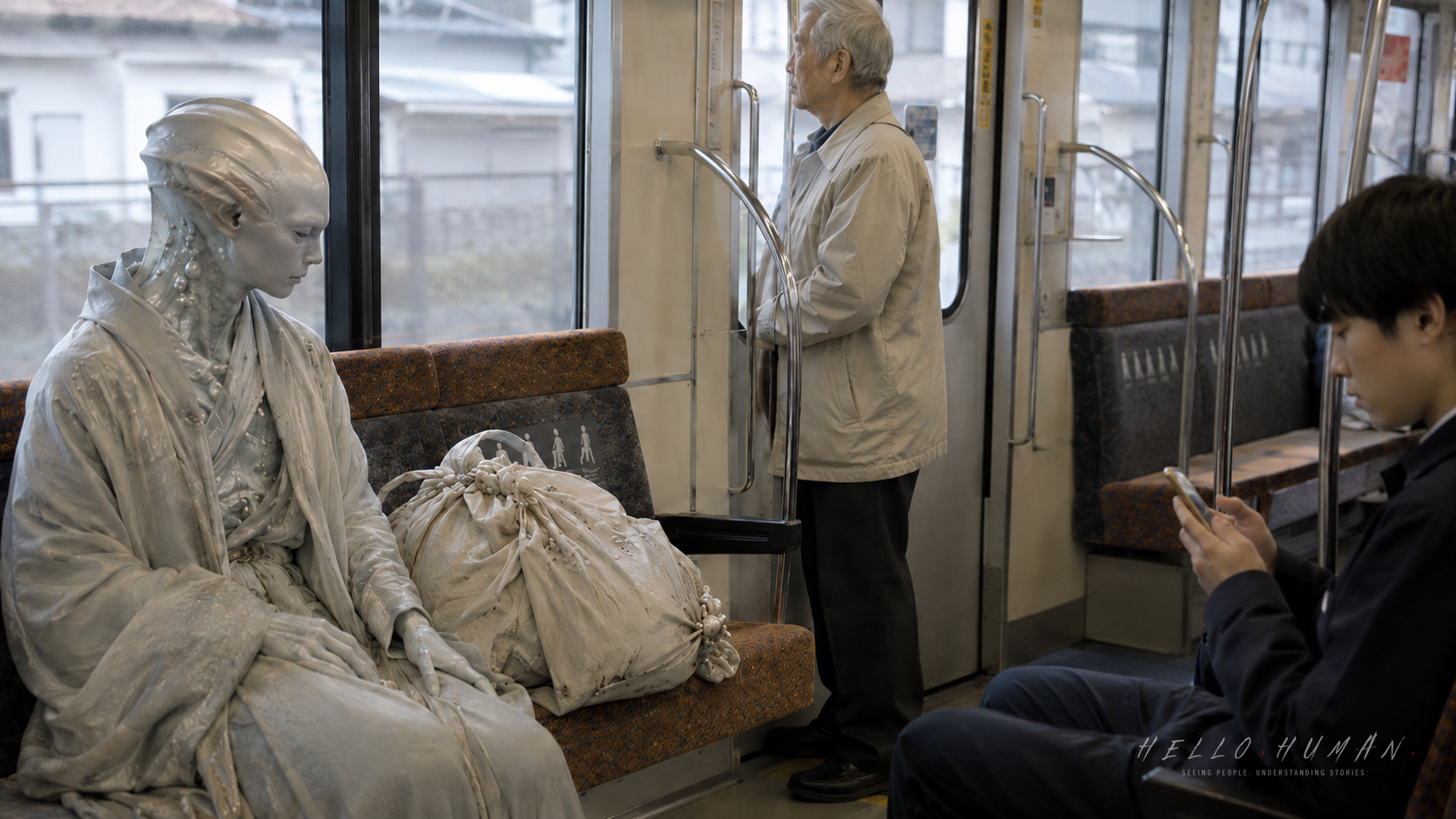
The Sendai train rocked once as it left the platform, and a pale traveler with pearl-sized gills along his neck lowered himself onto an empty seat near the end of the car.
His folded bundle slid beside his knee and covered the small blue priority seating marker on the wall.
Observation 01The Moment Something Changed

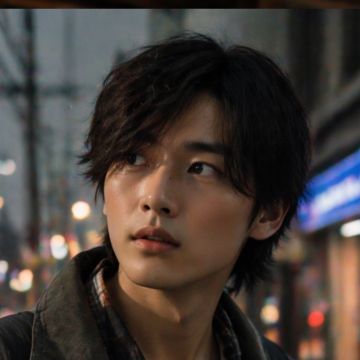
Naro had chosen the seat because it looked quiet. His body was compact but not human: his elbows folded slightly backward, his shell-pale throat moved in small wet pauses, and the pearl-like gills at his neck opened and closed as the train air dried them.
The seats around him were open. A young office worker stepped into the car, looked at the space, then stopped with one hand still on the strap. Her eyes moved from Naro’s bundle to the wall behind it.
An elderly man boarded at the next stop. He slowed near the priority seat area, then chose to stand by the door instead. He did not sigh. He did not point. He simply turned his body away as if the seat had already been taken.
Naro noticed the standing man and shifted his knees inward. The bundle stayed where it was, pressed lightly against the wall, hiding the marker that explained the area.
The first change was not verbal. People began treating an empty seat as unavailable.
The covered marker made the space harder to read, but the passengers still understood where they were.
No one corrected Naro directly; the warning appeared as hesitation and distance.
Observation 02The Reactions No One Explained
A mother with a stroller entered from the connecting door. She paused near the pole, looked at the open seats, and then touched the stroller handle twice without moving closer. Her child was quiet. The train was quiet around them.
Two students who had been talking softly lowered their voices when they saw the older man still standing. One of them glanced at the wall where the marker should have been visible. The other glanced at Naro, then quickly looked down at his phone.
A seated passenger across the aisle gathered his shopping bag closer to his shoes. He made room in a different direction, away from the priority area, as if creating another possible place without naming the problem.
At the next curve, Naro’s bundle slipped an inch lower. A corner of the blue marker appeared. The elderly man’s eyes caught it, then moved away at once.
Naro followed the movement too late. He saw only a small edge of color and the shape of a pictogram half-hidden by his cloth. His gills tightened, pearl by pearl, as if his neck had decided to become smaller before his mind understood why.
The passengers reacted by protecting the space indirectly: standing, waiting, lowering voices, and looking away.
Their glances were not curiosity about Naro’s body. They were checking the meaning of the seats.
In Japan, priority seats may remain socially reserved even when no one speaks and even when they appear empty.
Observation 03What the Traveler Finally Understood
Naro lifted the bundle first. He did it carefully, with both thin hands, as if the cloth had become louder than his voice. The marker came fully into view.
Then he stood. His knees folded in the wrong order for the narrow aisle, so the movement took a moment. He tucked the bundle against his chest and stepped toward the door area, leaving the seats open and visible.
The mother with the stroller did not rush forward. She waited one breath, then moved closer to the pole beside the priority seats. The elderly man shifted too, not into the seat, but nearer to the area where he could sit if he needed to.
Naro lowered his head. The gills at his neck closed neatly, a small polite seal along his throat. He had not been scolded. That made the lesson feel quieter, not lighter.
He understood that the seat was not empty in the simple way he had first seen it. It was held open by a shared awareness: for older passengers, pregnant passengers, injured passengers, disabled passengers, and others who might need it before anyone wanted to ask.
The correction came physically first: Naro uncovered the marker, folded in his belongings, and left the priority area clear.
The train relaxed without applause or explanation. People only adjusted back into a more readable shape.
The practical message was in the space itself: some seats carry a purpose even before the person who needs them appears.
Practical Takeaway
On trains and buses in Japan, look for priority seating markers near the seat, wall, window, or hanging signs before sitting. Keep bags, coats, suitcases, and your body from covering those markers, and move away when someone nearby may need the space more.
This matters because people often avoid direct correction in shared public transport. A seat can stay socially reserved through glances, hesitation, and people choosing to stand rather than ask.
Pay special attention near the ends of train cars, beside doors, and in seats with different colors or nearby pictogram markers. Empty does not always mean ordinary.